
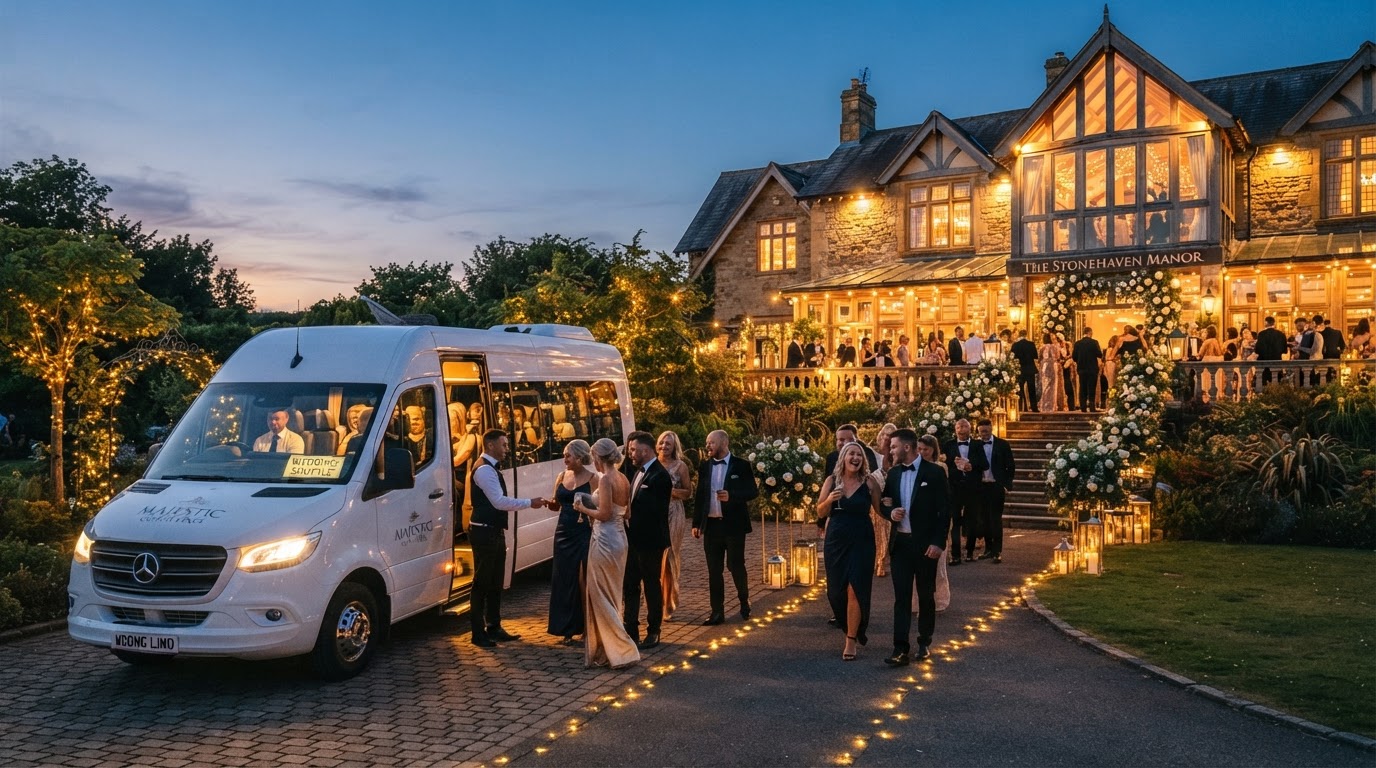
From shuttle loops and multi-hotel pickups to timing late-night returns and comparing costs, this guide covers everything you need to organise seamless wedding and event guest transport across Sydney.
Why Guest Transport Is the Hidden Variable in Event Success
You have chosen the venue, curated the menu, finalised the seating plan, and spent hours selecting the perfect playlist. But if your guests cannot get to the venue — or, more critically, get home safely at the end of the night — the entire experience unravels.
Wedding guest transport in Sydney is the element that couples and event planners most frequently underestimate. It is the one detail that can quietly elevate a good event into an unforgettable one, or turn a meticulously planned celebration into a logistical headache.
Sydney's geography makes this particularly challenging. Many of the most sought-after wedding and event venues are located in areas where public transport is limited and rideshare availability is unreliable — particularly after 11 PM.
Camden Valley function venues, Hunter Valley winery estates, and private properties in the Campbelltown & Camden region are stunning settings, but they are not places where guests can easily hail a taxi at midnight. Organised group transport solves this problem entirely.
Key Takeaway
This guide covers every decision involved in planning wedding and event guest transport in Sydney — from choosing between shuttle loops and single runs, to coordinating multi-hotel pickups, to timing evening returns, to comparing the real costs of private charter versus rideshare vouchers. Whether you are planning an intimate 30-guest wedding or a 150-person corporate gala, the principles are the same: clarity, coordination, and a reliable operator.
Shuttle Loops vs Single Runs: Which Is Right for Your Event?
The first structural decision is whether to run a continuous shuttle loop or schedule discrete pickup and drop-off runs. Each approach has distinct advantages, and the right choice depends on your guest count, venue location, and event timeline.
Shuttle Loops
Shuttle loops involve a single bus (or a pair of buses) running a continuous circuit between a designated pickup point — typically a hotel, car park, or public transport hub — and the venue.
Guests arrive at the pickup point at their convenience and board the next available shuttle. This works beautifully for events with a flexible arrival window, such as all-day weddings with a cocktail hour that accommodates latecomers.
The advantage is simplicity: guests do not need to commit to a specific departure time, and the bus absorbs the natural variability of guest arrivals. The disadvantage is that you need enough buses to keep wait times reasonable — typically no more than 30 minutes between shuttles.
Single Scheduled Runs
Single scheduled runs involve one or two fixed departure times from a pickup point, with all guests travelling together. This is ideal for events with a hard start time — a wedding ceremony, a corporate awards dinner, a theatre performance.
The advantage is that everyone arrives together, the timeline is predictable, and the cost is lower because you are paying for fewer vehicle-hours. The disadvantage is that late guests miss the bus.
For a wedding shuttle service in NSW, a common hybrid approach is a single inbound run for the ceremony, followed by a shuttle loop during the reception for guests who need to leave early, and a final scheduled return run at the end of the night.
Fleet Advantage
Our 14 to 24-seater air-conditioned minibuses are ideal for shuttle loops because they are large enough to move a meaningful group per trip but small enough to navigate venue access roads that larger coaches cannot. For events in the Hills District around Castle Hill and Norwest, where venue access can involve narrow suburban streets, this manoeuvrability is a significant advantage.
Managing Multi-Hotel Pickups Without the Chaos
When guests are staying across multiple hotels — common for destination weddings or events with interstate attendees — the pickup logistics become more complex. The key is to designate a single consolidation point and run a structured pickup sequence rather than attempting ad-hoc collections.
- Designate a primary hub: Choose the hotel with the most guests as the main departure point. Guests from other hotels can either walk (if close) or take a short rideshare to the hub.
- Schedule a sequential pickup: If hotels are spread across a reasonable radius, the bus can do a planned circuit — Hotel A at 5:15 PM, Hotel B at 5:30 PM, arrive at venue at 6:00 PM. Communicate these times to guests in advance.
- Assign a transport coordinator: Designate one person (a groomsman, bridesmaid, or event staff member) as the point of contact for the driver. They confirm headcounts at each stop and handle any last-minute changes.
- Build in buffer time: Always allow 10–15 minutes of buffer. A single delayed guest should not derail the entire schedule.
Communication is the critical factor. Provide every guest with a printed or digital transport schedule at check-in, including pickup times, locations, the driver's contact number, and the return schedule. A well-informed guest is a cooperative guest.
Timing Evening Return Transfers: The Make-or-Break Detail
The most common transport failure at weddings and events is the evening return. Guests are relaxed, the bar has been busy, and suddenly it is midnight and 80 people need to get home.
Rideshare surge pricing kicks in, wait times balloon, and the end of a beautiful evening becomes a stressful scramble. This is entirely avoidable with a planned return transfer.
Timing Rule
Schedule the final return run for 30 to 60 minutes after the official event end time. Guests rarely leave exactly on the dot — they linger, say goodbyes, and take photos. Building in a buffer means the bus is waiting when they are ready, rather than the other way around.
For events with a wide range of departure preferences, consider two return runs: an earlier one at, say, 10:30 PM for guests with children or early commitments, and a final one at midnight or whenever the venue closes.
Confirm the return pickup location clearly. At outdoor venues, the after-dark pickup point may differ from the daytime drop-off point due to lighting, access, or venue staff directions. TTSS drivers will scout the safest, most accessible pickup position during the initial drop-off and communicate it to your coordinator.
Cost Comparison: 14–24 Seater Charter vs Rideshare Vouchers
Many couples and event planners initially consider rideshare vouchers as a flexible, modern alternative to organised bus transport. On the surface, it seems elegant — give each guest a voucher code and let them travel on their own schedule.
In practice, the economics and reliability rarely hold up, particularly for evening events in Sydney's outer suburbs. Here is a realistic comparison for a 60-guest wedding in the Camden Valley area, with guests staying at hotels in Campbelltown:
| Factor | 14–24 Seater Private Charter | Rideshare Vouchers (60 guests) |
|---|---|---|
| Upfront cost | Fixed quote, all-inclusive | Variable, surge-dependent |
| Evening return reliability | Guaranteed — bus is pre-booked | Unreliable after 11 PM in outer suburbs |
| Cost per guest | Predictable, often $15–$25/head | $30–$80/head during surge |
| Group cohesion | Guests travel together | Fragmented, some may struggle to find a ride |
| Safety | Professional accredited driver | Variable driver vetting |
| Coordination effort | One booking, one driver | 60 individual rides to manage |
The comparison is stark. Rideshare vouchers appear flexible but introduce cost uncertainty, reliability risk, and coordination complexity. A private charter bus provides a single, fixed cost, guaranteed availability, and a professional driver who is accountable for getting every guest home safely.
Venue Access and Route Planning for Sydney Wedding Locations
Sydney's wedding venues span from inner-city rooftops to rural vineyards, and each presents unique access considerations. A 24-seater bus cannot turn around in a narrow country lane, and a 14-seater minibus may be required for venues with restricted access.
When booking, provide your operator with the venue address and ask them to assess access in advance. TTSS drivers plan routes to avoid known traffic bottlenecks and confirm that the vehicle can safely enter and exit the venue — including turning radius, parking, and any height or weight restrictions.
For venues in the Hunter Valley, Blue Mountains, or Southern Highlands, factor in travel time generously. A 90-minute drive can become two hours on a Saturday afternoon with weekend traffic. Build your event timeline around realistic transport windows, not optimistic estimates.
Booking Tips: What to Confirm with Your Operator
When booking event transport, confirm the following in writing. A professional operator will provide a written confirmation covering all of these points:
- Total cost: Including all fees and GST, with no hidden surcharges
- Vehicle details: Size and type allocated for your event
- Pickup and drop-off: Addresses and times confirmed
- Driver contact: Mobile number provided for the day
- Return schedule: Final departure time with buffer built in
- Cancellation policy: Terms documented before booking
- Additional requirements: Such as waiting time during the event
TTSS provides fixed, all-inclusive quotes with no hidden surcharges, and we confirm every detail in writing before the event.
Event Transport Planning Checklist
- Guest count: Numbers and pickup locations confirmed
- Transport model: Shuttle loop or scheduled runs decided
- Return transfer: Time scheduled with buffer
- Coordinator assigned: Point of contact briefed and ready
- Guest schedule: Transport times distributed to all guests
- Venue access: Vehicle access confirmed with operator
- Driver details: Contact shared with coordinator
- Fixed-price quote: Received and confirmed in writing
Conclusion: Transport as Part of the Celebration
Well-planned guest transport is not just a logistical necessity — it is part of the hospitality of the event. Guests who are collected, delivered, and returned safely and comfortably remember the experience fondly. Guests who are left stranded at midnight do not.
By choosing a professional, accredited operator and planning the details in advance, you turn transport from a potential failure point into a seamless extension of your event.
Ready to Book?
TTSS Coach Tours specialises in stress-free wedding and event guest transport across Sydney. Get a free, fixed-price quote and let us handle the logistics while you enjoy the celebration.